Not Wanting to Exist
When the Old Self Is Done—and the New One Hasn’t Arrived Yet
There have been two distinct seasons in my life when I didn’t care whether I lived or died.
I wasn’t suicidal.
I wasn’t planning anything.
I simply felt… done.
Done performing.
Done expecting.
Done trying to become some version of myself I thought I should want.
Done believing I had life figured out.
The first time this feeling appeared was right before I stopped drinking.
The second time came years later—and I allowed myself to grow still.
What surprised me most wasn’t the heaviness of the feeling.
It was how quiet it was.
No drama.
No despair.
Just a profound indifference toward existing as I had been.
A Misunderstood Feeling
Recently, I listened to a talk referencing Carl Jung—whose work deeply influenced early approaches to addiction and spirituality. One line stopped me in my tracks:
The desire to not exist is often misunderstood.
It is not a wish for death.
It is the ego dying.
That landed.
Because what if this feeling—the one we rush to escape, fix, numb, or pathologize—is actually a threshold?
What if it isn’t a sign that something is wrong…
but that something is ending?
The Ego, the Pink Cloud, and What I Claimed Anyway
In recovery spaces, there’s a term called the pink cloud—a phase of lightness and optimism that’s often treated with suspicion. You’re warned it won’t last. You’re told you’ll fall. The ego always comes back.
What most people don’t know is that the term originated in psychological discussions about ego detachment.
When I stopped drinking, people said I was “on a pink cloud.”
I owned it.
I was happy.
I felt free.
I was excited to see who else I could be.
I felt alive in possibility.
So I named my business Pink Cloud Coaching—even though I understood that the phrase wasn’t meant as a compliment, it made all the difference in my journey.
And maybe that’s where my work truly began.
Because while I deeply respect that many people are helped through traditional recovery models, I also know—through lived experience—that for some of us, returning again and again to the same identity, the same stories, the same framing, keeps us circling instead of evolving.
Stories, Egos, and the Risk of Staying the Same
Storytelling matters. I tell stories too. Stories help us feel less alone.
But when stories become exaggerated, rehearsed, or rewarded for their intensity, something subtle happens:
the ego gets louder.
And instead of moving forward, we stay anchored to who we were at our worst.
That’s not a judgment. It’s an observation.
In my work, I don’t want you to believe me.
I want you to question everything—especially the assumptions you’ve made about your life, your patterns, and what this moment means.
Because curiosity is far more powerful than certainty.
When You Stop Wanting to Exist
When someone reaches the place of not caring whether they exist anymore, the instinct is to panic—or to try to get back to who they used to be.
But what if that’s the wrong direction?
What if this moment isn’t a failure…
but a doorway?
Not wanting to exist as you’ve been may be the psyche saying:
This version of you is complete.
And when we don’t understand that, we repeat patterns.
We return to numbing behaviors.
We grasp for familiarity—even when it no longer fits.
Not because we’re weak.
But because we’re standing at the edge of something new without a map.
I Don’t Have Answers—But I Have Better Questions
I’ve spent my life observing, listening, and asking questions.
Sometimes too many.
Sometimes at the expense of my own certainty.
But that curiosity is also what makes me a guide.
I don’t want to tell you who you are.
I want to help you ask who you’re becoming.
Because that space—the one where you no longer want to exist as you were—is not the end.
It’s a pause between lives.
A liminal space.
The in-between.
And what I see now—what I could never quite articulate before—is this:
Pink clouds only exist in liminal space too.
They appear at dusk and at dawn,
in the brief moments between day and night,
between what was and what’s coming.
So what if this feeling—not wanting to exist, but not wanting to die—
isn’t a descent into darkness at all?
What if it’s an invitation to reimagine this space
not as doom and gloom,
but as a threshold brushed in pink clouds?
In more than twenty years of sobriety, I’ve had language for recovery, ego, healing, and awakening.
But as with most of my findings through lived evidence, there wasn’t a name for this distinction:
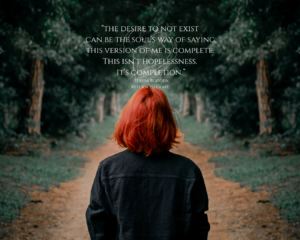
That the desire to not exist
can be the soul’s way of saying,
this version of me is complete.
This isn’t hopelessness.
It’s completion.
And when we misunderstand it, we rush to escape—
numbing it, diagnosing it, or trying to resurrect who we used to be.
But when we honor it,
we allow ourselves to stay in the in-between long enough
to notice the sky changing.
This is the only place pink clouds can live.
And if we’re willing to stay present instead of numbing or retreating, it may be the beginning of the most honest chapter yet.
You are so loved.
And you are not lost.
You are in transition.

Teresa Rodden Return to Light
About the Author
Teresa Rodden is the author of Return to Light and the creator of the Return to Light Gatherings and 28 Day Return to Light, a transformative approach for women in their prime who feel disconnected, numb, or quietly trapped in lives that no longer reflect who they’ve become. For over fifteen years, Teresa has helped women release numbing habits, reconnect with their inner light, and discover new possibilities without labels, shame, or recovery culture. Her work offers a safe, judgment-free space for women to explore their truth, honor their deepest knowing, and choose the life their soul is asking for. Teresa believes every woman carries a light meant to guide her home to herself — and that it’s never too late to begin again.